Longevity is a signal
Two decades of staying power is rarely an accident. The more interesting question is what Java kept getting right.
Coming December 7, 2026
Why does Java still hold the line when systems need to survive? Buzzing Java follows the engineering habits, trade-offs, and quiet advantages behind its remarkable staying power in the age of AI.
Get the Free Chapter + Launch PriceUntil launch
Buzzing Java is here.
Launch event: Bengaluru, India
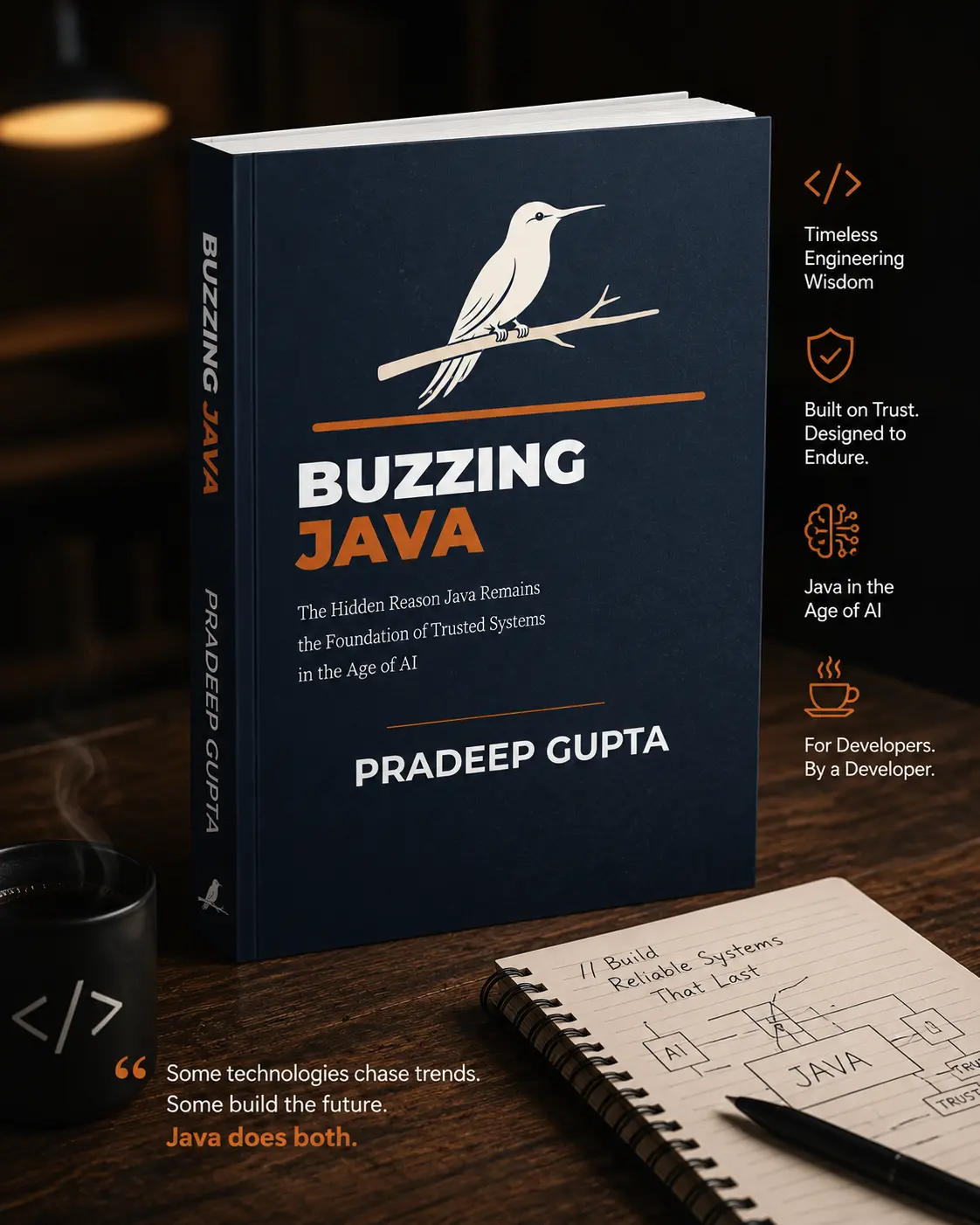
Buzzing Java distills three decades of system design and Java principles into a working playbook for enterprise systems that hold up in the AI era — not nostalgia, but the ideas that never went out of date.
Years of framework-churn — Spring Boot magic, cloud-native scaffolding, AI code generation — have let foundational design thinking erode, even among experienced engineers. Junior developers often never encountered these principles at all. Buzzing Java closes both gaps: a refresher for the senior engineer, a head start for the junior one.
Written from inside the systems where reliability is not a slogan.
Built and maintained JVM-based systems processing 40M+ events/day — the same runtime guarantees this book argues AI-generated code still can't replace.

Eleven reclaimed buzzwords. Three parts. One argument.
Get the launch date and price first, then choose how much of the conversation you want to join.
Hear first, before the public announcement.
Join online or offline, on your terms.
Unlock a second free chapter, 'Change Is the Only Constant,' the day you join.
Be first in line for thoughtful bonuses.
Buzzing Java explains why Java remains important in trusted enterprise systems and what its longevity teaches us about real-world engineering in the AI era.
It is for Java builders, technical leaders, architects, interviewers, and curious engineers who want to understand durable systems.
Framework churn affects everyone. Senior engineers often carry undocumented instincts about design that this book makes explicit and teachable; junior engineers get the same grounding years earlier than they'd otherwise find it.
No. It is a perspective-driven book about engineering judgment, system trust, and Java's role in production, not a syntax tutorial.
AI accelerates how fast code gets written, not how reliable it is. Java's memory model, thread-safety contracts, and type system don't ask whether code came from a human or a model — they enforce the same guarantees either way. That's the argument this book makes, with the JVM internals to back it up.
The planned launch date is December 7, 2026. Join the waitlist for updates.
Share your name, email, and launch-party preference in the short form on this page.
Waitlist members hear about the launch date and price first, and may receive a launch-party invitation and early book preview.